Subtotal $0.00

Feel Free To Contact Us at
- Phone:(888)-896-5577
- Email:dr.koffler@hmwcenter.com

Subscribe to our Newsletter and get the latest updates in the field of Holistic Medicine
Certain treatments targeting the calcitonin gene-related peptide (CGRP) pathway have an established role in preventing migraine. CGRP is a naturally occurring peptide involved in pain signaling and migraine biology. Medications that block this pathway can help reduce migraine frequency in appropriate patients.
However, not all peptide therapies work the same way. CGRP-targeting medications are a specific category of migraine treatment, while wellness peptides such as BPC-157, CJC-1295, and Selank have not been established as treatments for headaches or migraines.

Migraine is a neurological condition that causes recurring attacks of moderate-to-severe head pain. The pain is often throbbing or pulsating and may affect one side of the head, although it can occur on both sides.
Migraine attacks can last from several hours to multiple days. Some people experience them occasionally, while others have frequent or chronic migraine.
Not every recurring headache is a migraine. Other common types include:
Often cause a dull, pressing, or tightening sensation around the forehead, temples, or back of the head. Stress, poor sleep, and muscle tension may contribute.
Cause severe, usually one-sided pain around or behind the eye. Attacks may occur in repeated patterns and can be accompanied by tearing, nasal congestion, or redness of the eye on the affected side.
Can develop or worsen when acute headache medicines are used too frequently over time.
Facial pressure and pain may occur with certain sinus conditions, often alongside nasal congestion or discharge. However, migraine can also cause facial pressure and nasal symptoms, so accurate diagnosis matters.
Headaches can involve several interacting factors, including nervous system activity, genetics, hormonal changes, sleep patterns, and environmental triggers.
For migraine, changes in brain signaling and the activation of pain-related pathways play an important role. One molecule that researchers have studied extensively is calcitonin gene-related peptide, commonly known as CGRP.
Factors that may contribute to headache episodes include:
Triggers vary between individuals. Keeping a headache diary can help identify patterns and provide useful information during a medical consultation.
Peptides are short chains of amino acids that act as signaling molecules in the body. They help regulate a wide range of biological processes, including hormone signaling, immune responses, and communication between cells.
Some peptides are involved in the nervous system and the body’s response to pain. CGRP is one example.
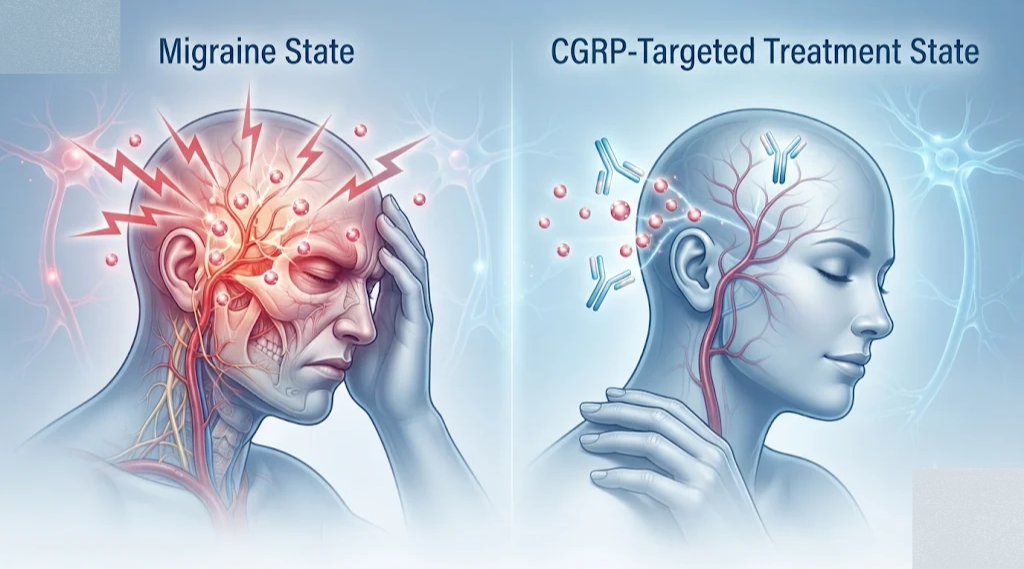
CGRP is a naturally occurring neuropeptide found in the nervous system. It plays a role in migraine-related signaling and can contribute to the processes involved in migraine attacks.
During migraine, CGRP signaling can influence pain pathways and the activity of blood vessels and surrounding nerve structures. This discovery has helped researchers develop treatments that specifically target the CGRP pathway.
The important distinction is that CGRP-targeting migraine medications are not the same as general wellness peptide injections. Their development, clinical evidence, intended use, and safety monitoring are specific to migraine treatment.
CGRP-targeting treatments are designed to block the activity of CGRP or its receptor, reducing signaling involved in migraine attacks.
There are two main categories:
These are laboratory-developed antibody medicines that target either CGRP itself or the receptor it binds to.
Depending on the medication, administration may involve an injection under the skin or an intravenous infusion. Many are used for preventive migraine treatment, with dosing schedules that vary by product.
Gepants are small-molecule medicines that block the CGRP receptor. They are not peptide injections or monoclonal antibodies.
These medicines have different indications, routes of administration, and dosing schedules. A healthcare professional can determine which, if any, is appropriate.
The American Headache Society’s 2024 position statement supports CGRP-targeting therapies as a first-line preventive option for migraine, alongside other established treatments.
For people with an appropriate migraine diagnosis, CGRP-targeting medications may offer several benefits.
Preventive CGRP treatments can reduce the number of migraine days experienced by some patients. This may be particularly helpful for people who experience frequent attacks.
Some patients experience less severe or less disruptive migraine episodes with preventive treatment. Acute CGRP-targeting medicines may also help treat an attack when it occurs.
Reducing migraine frequency may make it easier to maintain work, exercise, sleep, and social activities.
CGRP-targeting medicines provide another treatment approach for people who have not benefited from traditional preventive medicines or who cannot tolerate them. Current guidance also recognizes them as an option without requiring failure of other preventive medication classes first.
Results are not guaranteed. Treatment response varies, and a clinician should periodically review effectiveness, side effects, and ongoing need.
People researching peptide therapy may encounter products such as BPC-157, CJC-1295, Ipamorelin, DSIP, Epithalon, and Selank.
These compounds are discussed in wellness and research settings for different proposed purposes. However, their presence on a peptide therapy list does not mean they have been clinically established for headache or migraine treatment.
For example:
Primarily discussed in experimental research involving tissue repair and healing. There is insufficient reliable human evidence to recommend it for migraine or recurring headaches.
Affect growth hormone signaling. They are not established treatments for headache disorders.
Has been investigated in relation to sleep and neurological processes, but evidence does not establish it as a headache treatment.
Experimental peptides discussed in relation to neurological and cognitive functions. Their effectiveness and safety for headache treatment have not been established through adequate clinical evidence.
Investigated for proposed biological and aging-related effects, but it is not an established migraine therapy.
The distinction matters because a treatment’s proposed biological mechanism does not prove that it improves a particular medical condition. More rigorous human research is needed before these peptides can be recommended for headaches.
Acute treatments are used when a headache or migraine attack begins. Depending on the diagnosis, options may include:
Taking acute medication too frequently can contribute to medication-overuse headaches. Follow the recommended dosing instructions and discuss frequent use with a healthcare professional.
Preventive treatment may be considered when headaches are frequent, disabling, or difficult to manage with acute medication alone.
The appropriate choice depends on the type of headache, other medical conditions, potential side effects, and personal treatment goals.
Medical treatment may be supported by practical habits such as:
Lifestyle changes do not replace medical treatment, but they may help reduce the impact of certain headache triggers.
Safety depends on the specific medication or peptide, its intended use, dose, formulation, and the individual’s health history.
CGRP-targeting medicines have been evaluated in clinical studies and have established prescribing information. However, they can still cause side effects.
For example, constipation and injection-site reactions are recognized concerns with certain CGRP-targeting medicines. Some patients may require additional monitoring based on their medical history.
Unapproved or experimental wellness peptides raise separate concerns. Their long-term safety, appropriate dosing, purity, and effectiveness may not be adequately established. Compounded products are not automatically FDA-approved or proven safe and effective for a particular condition.
A qualified healthcare professional should review these factors before recommending treatment.
Most headaches are not emergencies, but certain symptoms require immediate medical evaluation.
Arrange a medical assessment for headaches that are becoming more frequent, changing in pattern, disrupting daily activities, or requiring repeated use of pain medication.
A proper diagnosis is important before starting any preventive or peptide-related treatment.
The term can refer to different approaches. In migraine medicine, the best-established peptide-related pathway is CGRP, which is targeted by specific prescription medications. General wellness peptides have not been established as treatments for headaches.
Yes. CGRP-targeting medications are established preventive options for appropriate patients with migraine. They may reduce migraine frequency and improve daily functioning, although individual responses vary.
No. CGRP monoclonal antibodies are specialized prescription biologic medicines designed to target the CGRP pathway. They are not interchangeable with wellness peptides such as BPC-157 or CJC-1295.
There is insufficient reliable clinical evidence to establish BPC-157 as an effective migraine treatment. It should not be considered a proven alternative to established headache therapies.
The response varies depending on the medicine and the individual. Some people notice changes within the first few weeks, while others require a longer observation period. A prescribing clinician can determine when treatment should be evaluated.
No. Suitability depends on the migraine diagnosis, medical history, other medications, and the specific product's prescribing information. A healthcare professional should assess potential benefits and risks before treatment.
Consistent sleep, hydration, regular meals, stress management, and identifying personal triggers may help some people reduce migraine burden. These strategies can complement, but do not necessarily replace, medical treatment.
Recurring headaches can affect nearly every part of daily life, from concentration and productivity to sleep and overall well-being. Understanding the underlying cause is an important first step toward finding an appropriate treatment.
Research into CGRP has expanded migraine care, providing targeted prescription options for people who may benefit from them. However, not every peptide has the same evidence, purpose, or safety profile. General wellness peptides should not be presented as proven headache treatments.
At Holistic Medical Wellness, a physician-guided approach begins with understanding individual health concerns and treatment goals. If you are experiencing recurring headaches or migraines, a medical consultation can help determine whether further evaluation, established migraine treatment, or another care approach is appropriate.
Interested in exploring peptide therapy? Learn more about Holistic Medical Wellness peptide therapy and schedule a consultation to discuss your health history and treatment questions.
This article is for educational purposes only and does not provide medical advice, diagnosis, or treatment. CGRP-targeting medicines are established prescription options for certain migraine indications, but general wellness peptides such as BPC-157, CJC-1295, and Selank are not proven headache treatments. Treatment decisions should be made with a qualified healthcare professional. Seek emergency medical attention for sudden severe headaches or headaches accompanied by neurological symptoms.