Subtotal $0.00

Feel Free To Contact Us at
- Phone:(888)-896-5577
- Email:dr.koffler@hmwcenter.com

Subscribe to our Newsletter and get the latest updates in the field of Holistic Medicine

How can three letters—DAC—change the way a peptide behaves for several days?
In an early human study, long-acting CJC-1295 had an estimated half-life of approximately 5.8 to 8.1 days. A single administration increased average growth hormone levels for at least six days and IGF-1 levels for approximately 9 to 11 days.
CJC-1295 is a laboratory-made version of growth hormone-releasing hormone, also known as GHRH. Instead of supplying growth hormone directly, it signals the pituitary gland to release more of the body’s own growth hormone.
CJC-1295 is commonly discussed in two forms:
This difference may affect how long the peptide remains active, its effect on growth hormone release, and how frequently it is used
CJC-1295 is a laboratory-made peptide designed to act like growth hormone-releasing hormone, also known as GHRH.
GHRH is naturally produced in the brain. It signals the pituitary gland to release growth hormone. CJC-1295 follows this same pathway instead of supplying growth hormone directly.
When growth hormone levels rise, the liver may produce more insulin-like growth factor 1, or IGF-1. These hormones play important roles in metabolism, bone health, tissue growth, and the body’s normal repair processes.
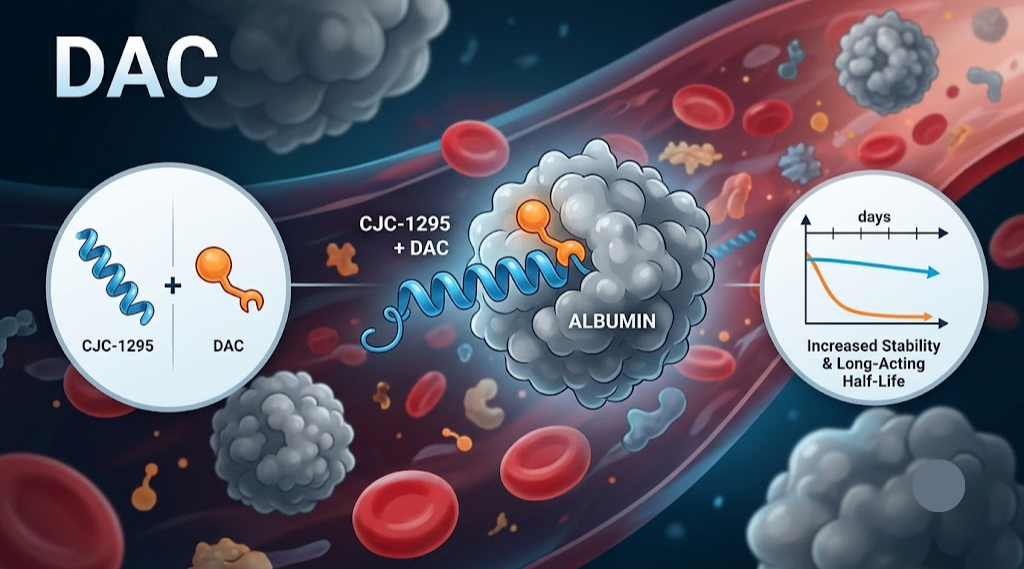
DAC stands for Drug Affinity Complex. It is a small chemical attachment added to the peptide to help it stay in the bloodstream longer.
The DAC portion allows CJC-1295 to attach to albumin, a protein naturally found in the blood. Albumin acts like a carrier, protecting the peptide from being broken down too quickly.
Because of this attachment, CJC-1295 with DAC can remain active for several days. Without DAC, the peptide is removed from the body much faster.
CJC-1295 with DAC is the long-acting version of the peptide. It was developed to produce a longer-lasting increase in growth hormone and IGF-1 than short-acting GHRH-based compounds.
In an early human study, its estimated half-life was approximately 5.8 to 8.1 days. A single administration increased average growth hormone levels for at least six days, while IGF-1 remained elevated for approximately 9 to 11 days.
Its longer activity may make it more convenient because it does not leave the bloodstream quickly. However, this also means its effects cannot be adjusted or stopped as quickly if unwanted symptoms develop.
Although CJC-1295 with DAC is often promoted for muscle growth, fat loss, recovery, and anti-aging, the available human research mainly shows changes in hormone levels. It does not confirm that everyone will experience these physical benefits. The FDA has also raised concerns about the limited safety information available for compounded CJC-1295 products.
CJC-1295 without DAC is the short-acting version that does not include the albumin-binding Drug Affinity Complex.
Because it lacks this attachment, the peptide is broken down and removed from the bloodstream much faster than the DAC version. Its activity is generally measured in minutes rather than days, although the exact half-life can vary depending on the compound and formulation.
The name can also be confusing. Products sold as “CJC-1295 without DAC” are often labeled Mod GRF 1-29, but these names are not always scientifically interchangeable. The FDA evaluates non-DAC CJC-1295 substances separately as CJC-1295 free base and CJC-1295 acetate.
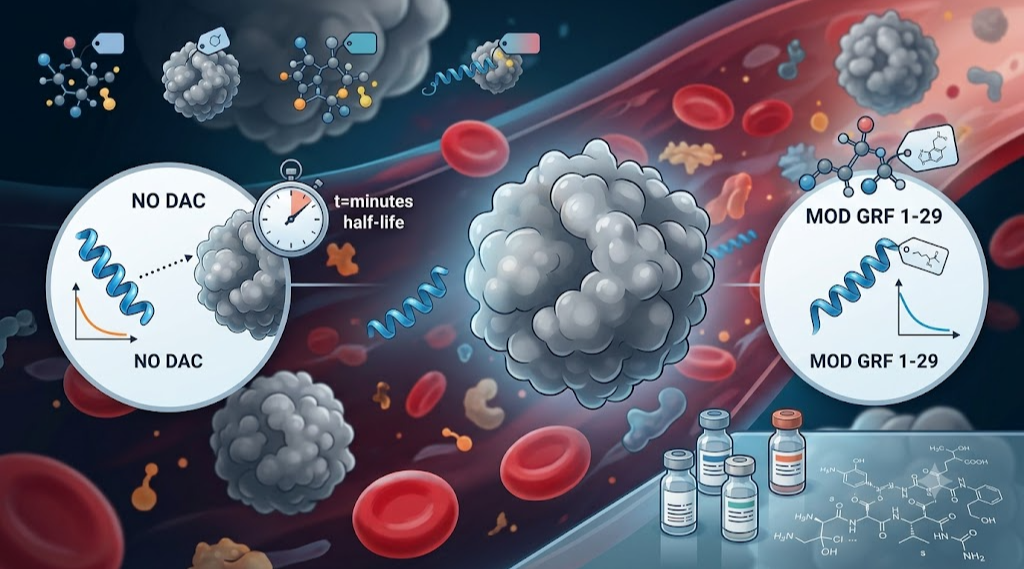
The names CJC-1295 without DAC and Mod GRF 1-29 are often used as if they describe the same peptide. However, the terminology is not always scientifically precise.
Mod GRF 1-29 is a short-acting, modified form of the first 29 amino acids found in natural growth hormone-releasing hormone. Many peptide sellers market this compound under the easier-to-recognize name “CJC-1295 without DAC.”
The original CJC-1295 studied in human clinical research was developed as a longer-acting compound with DAC. The FDA also identifies several CJC-1295-related substances separately, including CJC-1295 free base, CJC-1295 acetate, and different forms containing DAC.
This naming confusion matters because two products carrying similar labels may not have the same chemical form, strength, purity, or biological activity.
The biggest difference between the two versions is how long they remain active. CJC-1295 with DAC stays in the body much longer, while the version sold without DAC produces a shorter response.
Feature | CJC-1295 With DAC | CJC-1295 Without DAC |
Duration | Long acting | Short acting |
Reported half-life | About 5.8–8.1 days | Exact duration is less clearly established |
GH response | Prolonged stimulation while natural pulses may continue | Briefer stimulation |
Convenience | Usually promoted as requiring less frequent use | Usually promoted as requiring more frequent use |
Timing control | Lower because it remains active longer | Higher because its effects wear off faster |
Response to side effects | Effects may take longer to fade | Effects may stop sooner |
Human research | Limited, but more clinical data are available | Product-specific human data are more limited |
FDA approval | Not FDA-approved | Not FDA-approved |
A common claim is that the DAC version creates completely continuous growth hormone release. However, human research found that natural growth hormone pulses continued even while overall GH levels remained elevated.
Growth hormone is not normally released at one steady level. The pituitary gland releases it in short bursts, called pulses, throughout the day and night. These pulses are influenced by sleep, exercise, food intake, age, and other hormones.
CJC-1295 with DAC raises the overall amount of growth hormone released over a longer period. However, it is misleading to say that it completely replaces natural pulses with constant “GH bleed.” A human study found that growth hormone pulses continued even while average and baseline hormone levels were elevated.
The non-DAC form creates a shorter signal. Because the effect fades more quickly, it is commonly described as producing a more pulse-like response. This is why it is often marketed as being closer to the body’s natural hormone pattern.

CJC-1295 with DAC is often promoted for recovery, body composition, sleep, and healthy aging. However, these possible benefits are mainly based on the known roles of growth hormone and IGF-1—not on strong clinical trials proving that CJC-1295 produces these results.
Potential benefits commonly associated with it include:
So far, human research has confirmed that CJC-1295 with DAC can raise growth hormone and IGF-1 levels. It has not yet proven that these hormone changes lead to reliable muscle gain, fat loss, faster healing, better sleep, or anti-aging results.
The main potential advantage of CJC-1295 without DAC is greater control over how long the hormone signal lasts. Because it acts for a shorter period, its effects are expected to fade sooner than those of the DAC version.
Other possible advantages include:
This shorter action is why the non-DAC form is often preferred by people who want a more physiological approach. However, “more natural” does not automatically mean safer or more effective.

CJC-1295 changes the growth hormone system, so its safety should not be judged only by whether an injection causes immediate discomfort. Some risks may involve hormone levels, the immune system, or the quality of the product itself.
Possible safety concerns include:
The FDA has identified serious reactions associated with CJC-1295, including increased heart rate and a body-wide blood vessel reaction. It has also warned that compounded peptide products may contain impurities or trigger an unwanted immune response.
Because CJC-1295 affects growth hormone and IGF-1, it may not be appropriate for everyone. Its long-term safety has not been established, and there is no FDA-approved prescribing guide for cosmetic, anti-aging, or performance use.
Extra caution is especially important for people who have:
People taking insulin, diabetes medicine, hormone therapy, or other peptides should also speak with a qualified healthcare professional before considering any growth hormone-related product.
Neither version is automatically better for everyone. The main difference is whether someone values a longer-lasting effect or a shorter, more adjustable response.
CJC-1295 with DAC may appeal more to people who prioritize convenience because it remains active much longer. However, the extended activity also means that unwanted effects may take longer to wear off.
CJC-1295 without DAC may appeal more to people who prefer a shorter hormone signal and greater control over timing. The tradeoff is that it is less convenient and is supported by less consistent product-specific research.
The better choice would depend on factors such as:
Convenience should not be the only deciding factor. Because neither version is FDA-approved for anti-aging, fat loss, muscle gain, or general wellness, a qualified healthcare professional should evaluate whether either option is appropriate.
Before considering CJC-1295, ask a qualified healthcare provider questions that help you understand the evidence, risks, and available alternatives.
Important questions include:
No. HGH injections provide growth hormone directly. CJC-1295 signals the pituitary gland to release more of the body’s own growth hormone.
The biggest difference is how long they remain active. The DAC version is long-acting, while the version without DAC produces a much shorter signal.
In an early human study, long-acting CJC-1295 had an estimated half-life of about 5.8 to 8.1 days. Changes in growth hormone and IGF-1 lasted beyond a single day.
The names are often used interchangeably by peptide sellers, but they are not always scientifically identical. Buyers should verify the exact chemical form instead of relying only on the product name.
There is no medically established “beginner” version. Neither form is FDA-approved for muscle building, fat loss, anti-aging, or general wellness, so the decision should not be based on online protocols.
CJC-1295 can increase growth hormone and IGF-1 levels, but current human research has not proven that it reliably produces meaningful muscle growth. Most studies measured hormone changes rather than physical results.
It is frequently marketed for fat loss, but there is not enough clinical evidence to confirm that CJC-1295 causes reliable or lasting weight loss. Lifestyle, medical conditions, and other treatments may have a greater effect.
Some users report changes in sleep, but strong clinical trials have not confirmed CJC-1295 as an effective sleep treatment. Poor sleep may have many causes that should be evaluated separately.
It may affect glucose and insulin function because growth hormone influences how the body processes sugar. People with diabetes, prediabetes, or insulin resistance should be especially cautious.
Long-term safety has not been established. Existing human trials were small and short, so they cannot confirm what may happen after repeated use for several months or years.
Hormone stimulation is expected to decrease after the compound wears off. The DAC version may take longer to leave the body, while the short-acting version is expected to wear off sooner.
CJC-1295 stimulates the pituitary instead of replacing growth hormone directly. However, the effects of prolonged or repeated use on the body’s hormone-regulation system have not been studied well enough to guarantee that natural production will remain unchanged.
No. CJC-1295 is not an FDA-approved medication. Compounded drugs are also not reviewed by the FDA for safety, effectiveness, or quality before being marketed.
The most important difference between these two peptides is not which one promises faster results. It is how long each version continues sending a growth hormone signal.
Adding DAC gives CJC-1295 a much longer-lasting effect, while the version sold without DAC is designed to act for a shorter period. Early research confirms that long-acting CJC-1295 can raise growth hormone and IGF-1, but it does not prove the muscle-building, fat-loss, recovery, or anti-aging results often promoted online.
Neither option should be considered automatically better or safer. CJC-1295 remains an unapproved peptide with limited long-term safety evidence, and the FDA has identified safety and product-quality concerns involving compounded versions.